Sierra accepts her werewolf identity and joins the Blue Blood Pack
Broken Rejected MateSierra accepts her werewolf identity and joins the Blue Blood Pack as a conditional act of survival rather than a simple homecoming. Ronald Lowell offers protection because he believes her Dysomnian nature can be controlled, especially through Alan Lowell, but he also sees her as an extraordinarily powerful asset. Sierra therefore enters the pack carrying two conflicting meanings: she is a young woman trying to live without harming anyone, and she is a politically valuable body whose blood, abilities, and future may be claimed by those in power.
The Threat Behind the Invitation
Ronald Lowell’s offer follows the discovery that a Dysomnian wolf is living on his territory and that the wolf is Doherty Langford’s daughter. His wording makes the danger unmistakable: Sierra has not been executed only because Ronald is willing to hold a meeting first. The alternative to joining is not ordinary exile but the expectation that Doherty Langford and Sierra will leave the territory immediately. The proposed membership is thus made under the shadow of a death sentence that has merely been postponed.
Ronald presents himself as pragmatic rather than merciful. He says that killing Dysomnias is wasteful and relies on the report from his sons that Alan Lowell was able to calm Sierra while she was in wolf state. Because she did not hurt them, Ronald concludes that she may not damage anyone else if Alan remains with her. This reasoning makes Alan’s presence a condition of Sierra’s acceptability: her safety within the pack depends on another person’s ability to regulate her, while her own account of her identity is treated as secondary.
A Conditional Place in the Pack
Ronald asks both Sierra and Doherty Langford to join the Blue Blood Pack, but he is candid about what he expects to gain. He wants Sierra to train with his sons and her mate so that she can reach her “true potential,” and he calls her a valuable asset to the pack. The invitation therefore combines shelter with appropriation. Sierra is not merely welcomed as a new member; she is evaluated as one of the most powerful wolves in the world, a resource whose abilities may strengthen Ronald’s authority.
Sierra resents being discussed as a commodity, and Alan’s clenched fists show that he shares her anger. Ronald’s proposal also exposes the limits of pack protection. The same institution that can prevent an immediate execution can reserve the right to measure, train, and deploy the person it protects. Sierra’s membership is consequently an example of protection that remains entangled with control: she is admitted because the pack believes it can benefit from her and because Alan can help contain her.
Doherty asks for time to consider the proposal, and Ronald grants him until the end of the week. If they refuse, he expects them out of his territory. After the meeting, Doherty sits with his head in his hands, frustrated and confused, before deciding that they should leave. His first response is to preserve Sierra through flight, reflecting the life they have already led while looking over their shoulders. Yet the decision becomes more complicated because Sierra cannot be separated from Alan without violating the obligations surrounding their mate relationship.
Sierra’s Choice and the Cost of Belonging
Doherty eventually agrees that they will join Ronald Lowell’s pack, but he makes the agreement explicitly provisional. At the slightest hint of danger, they will leave, and Sierra must begin considering how to persuade Alan Lowell to go with them if necessary. This condition preserves a small zone of independence inside the larger submission. Sierra accepts the pack’s shelter, but neither she nor her father accepts Ronald’s authority as automatically trustworthy.
Sierra also recognizes that Alan’s relationship with the Blue Blood Pack cannot be dismissed. The pack is his family and the only home he has known, and he has long hoped to lead it. She refuses to become the reason he abandons that future, even while believing that he would leave with her immediately if she truly needed him. Her decision thus joins self-preservation to restraint: she enters the pack without demanding that Alan sever the ties that define his own identity.
Alan later defends her membership directly when Anthony Lowell and Andrew Lowell lash out at her. He insists that she is an eighteen-year-old trying to live like everyone else and argues that, since Ronald trusts her, the twins should respect the alpha’s decision. He invokes the cousins’ earlier promise to protect one another’s mates and identifies Sierra as his mate. His intervention turns her admission from a private arrangement into a public obligation. The pack’s accepted duties toward mates become one of the few principles strong enough to challenge suspicion of her Dysomnian nature.
The Identity the Pack Cannot Contain
Sierra’s acceptance does not make her transformation safe or predictable. During a later shift, she changes easily, like slipping into a new outfit, but discovers that her wolf has not been quietly grieving. The wolf has been prowling and waiting to be released. Her father’s death has wounded that inner self, and the control developed through practice collapses as soon as the wolf begins to growl. Membership in the pack therefore does not resolve the division between Sierra and her wolf; it places that unresolved power inside a community already anxious about what a Dysomnian can become.
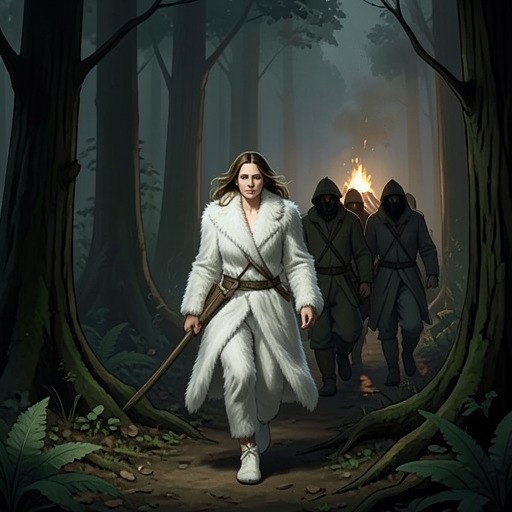
The danger is made stark when the huntress kills Doherty Langford with a sword. Sierra’s wolf takes control while Sierra remains in human form, allowing her to catch the weapon, seize it from the huntress, and drive it through the woman’s heart. The act protects Sierra from another attack, but it also confirms how quickly grief and violence can pass through the boundary between human body and wolf nature. Her identity is not a mask that can simply be removed. It is a fused condition in which the wolf can act through her even when she has not completed a physical transformation.
The history of Sierra’s mother explains why the pack’s fear has such force. Sierra’s mother was recognized as potentially Dysomnian from birth, and her pack initially wanted her killed. Her father’s position as alpha delayed the decision until her first shift, and her kindness eventually persuaded the pack that its fears were mistaken. The judgment proved correct only when she shifted and killed two pack members. Because she was pregnant, the pack postponed her execution until after she gave birth, treating the killing of a pregnant werewolf as sacrilege; immediately after Sierra’s birth, her mother was taken away and killed. Sierra consequently inherits not only a supernatural identity but also a history in which pregnancy temporarily protects a condemned body without challenging the authority that condemns it.
From Outsider to Political Possibility
Sierra’s presence enters the Blue Blood Pack’s wider struggle over leadership. Anthony Lowell and Andrew Lowell are close to Alan Lowell, yet their shared future includes a contest to determine who will become alpha. Alan intends to win, and his attachment to Sierra cannot be fully separated from that ambition because he fears that the twins may possess the darker qualities associated with their father. Sierra is therefore brought into a family and political structure already organized around secrecy, succession, and distrust.
The succession crisis becomes explicit when the pack later faces the absence of an alpha. Alana Lowell declines to govern until her son returns and states that Anthony Lowell has no desire to become the next alpha. The pack then turns to the only other wolf present with alpha blood: Alan Lowell. More than a hundred pack members hear him described as strong, courageous, merciful, and fair, while Sierra is recognized as a powerful mate who could help form a formidable alpha pair. Her membership has moved beyond the question of whether a Dysomnian may be tolerated. She becomes part of the possible future leadership of the pack.
That political future remains threatened by Ronald’s hidden motives. Sierra comes to suspect that Ronald Lowell was responsible for the deaths of Alan Lowell’s parents and that he intends to extract her power for his own purposes. The apparent offer of refuge can therefore be reread as a strategy for placing a powerful Dysomnian within reach. Sierra compares Ronald to Karl, a figure who killed his own family for power, and resolves that he will not escape accountability. The pack that once seemed like a possible sanctuary becomes the setting in which she must distinguish genuine belonging from a carefully engineered trap.
Consequences for Family and Future
Sierra’s admission ultimately produces a fragile network of mutual protection rather than uncomplicated security. Alan’s defense of her, Andrew Lowell’s later sacrifice while saving her from Ronald’s attack, and the twins’ place within the pack all show that her bonds can generate loyalty that exceeds suspicion. At the same time, Ronald’s violence demonstrates that blood ties and alpha authority can be turned against the very people they claim to govern.
Sierra and Alan’s eventual commitment to building a family gives her acceptance a further consequence. They decide to try for a child despite their earlier fear of raising a Dysomnian child with alpha blood, taking courage from Tony and Caroline’s success in raising their twins. Sierra’s pregnancy test is therefore more than a domestic detail: it joins her Dysomnian inheritance to Alan’s alpha lineage and transforms the once-persecuted identity that threatened to exclude her from the pack into a possible foundation for its future. Her entry into the Blue Blood Pack begins as conditional inclusion, but it ends with the prospect of a new family whose existence could alter the meaning of blood, leadership, and belonging.